

You sleep enough. You eat well. Your labs came back fine.
And you're still tired in a way that a good night doesn't fix — the kind where climbing the stairs registers, where your usual session feels like someone added weight to the bar, where your hair is coming out in the shower more than it used to.
You've probably been told it's stress, or your age, or that you should try to relax more.
Before you accept any of that, I'd want to see one number. It's cheap, it's on almost every panel, and it's the one I see missed most often.
What ferritin actually is
Iron does one job you know about — it carries oxygen in your blood — and a dozen you don't, including making the energy inside every cell.
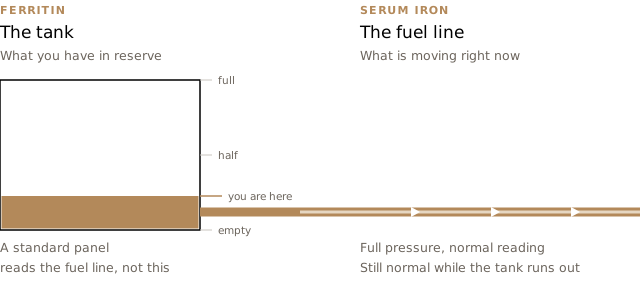
Ferritin is not the iron in your blood. Ferritin is the protein that stores iron, and measuring it tells you what's in the tank rather than what's in the fuel line.
You can have completely normal hemoglobin, no anemia, nothing flagged, and an empty tank.
Your body will protect your blood first and take everything else offline to do it. Hair, energy, exercise tolerance, focus. Those are what it spends before it lets your hemoglobin drop.
Why it matters — especially in midlife
Through perimenopause, cycles often get heavier and less predictable before they stop. Heavy bleeding is the single biggest reason women lose iron, and "heavy" is easy to normalize when it's been creeping up for years.
At the same time, absorption gets less efficient — and if you've been eating less red meat, training hard, or both, you're spending more and taking in less.
The result is a slow drain over years rather than a sudden drop, so it never feels like an event. It feels like getting older.
What low actually looks like
Not all of these, and not all at once. But if you're nodding at four or more:
- Tired in a way sleep doesn't fix
- Hair shedding — more in the brush, more in the drain
- Workouts that feel harder than they should, especially anything with a heart rate attached
- Cold hands and feet when nobody else is cold
- Restless, twitchy legs at night
- Brain fog that's worse in the afternoon
- Cracks at the corners of your mouth, brittle nails
- Craving ice, specifically. Worth mentioning to your doctor
Your optimal range is not the lab's range
Most labs will flag ferritin as low only below about 10 to 15 ng/mL. That threshold exists to catch anemia. It was never designed to answer "is she going to feel good and train well".
What I look for is considerably higher than that, and the research on symptoms rather than anemia supports it:
| Ferritin (ng/mL) | |
|---|---|
| Lab calls it low | under 10–15 |
| Where symptoms usually clear | 40–50 and up |
| Where I want most active women | 50–80 |
| Too high — investigate, don't supplement | over 200 |
Two warnings on reading your own result.
Ferritin rises with inflammation. It's an acute-phase reactant, which means an infection, a flare, or an injury can push it up and hide a deficiency underneath. A ferritin of 60 with a raised CRP is not the same as a ferritin of 60 with a normal one. Always read them together.
High ferritin is not "extra good." Above 200 it's a reason to look further, not a reason to feel pleased.
What pushes it the wrong way
- Heavy periods. By far the most common cause, and the most normalized.
- Not enough heme iron. Plant iron is real iron but you absorb far less of it. Eating no red meat is a choice you can make — it just has to be accounted for.
- Coffee and tea with meals. The compounds that make them good for you block iron absorption. An hour either side of a meal solves it.
- Endurance training. High volume increases losses through several routes at once.
- Gut issues. Celiac, low stomach acid, H. pylori and long-term acid blockers all reduce what you take in.
How to bring it back
Food alone will hold a level. It rarely rebuilds one from low.
If you're genuinely depleted you'll usually need a supplement, and the details matter more than the brand:
- Alternate days beats daily. Taking iron every day raises a hormone called hepcidin that blocks the next dose. Every other day absorbs better than daily.
- Take it with vitamin C, away from coffee, tea, calcium and dairy.
- Give it three to six months and retest. Ferritin moves slowly.
- Fix the cause at the same time. If the bleeding is heavy, supplementing alone is bailing without patching.
And on the food side: red meat, liver if you'll eat it, shellfish, and pairing plant iron with something acidic.

How we test it — test, don't guess
Ask for these four together:
Ferritin. CRP. Iron. Transferrin saturation.
Ferritin alone can mislead in both directions. CRP tells you whether to trust the ferritin. The other two show whether what's stored is actually being moved and used.
Retest three months after you change anything. Sooner than that, you're mostly measuring noise.

If this sounds like you
Low ferritin is common, it's cheap to check, and it's one of the few things on this list that can be genuinely fixed rather than managed.
It's also frequently missed, because the number sits inside a range that was built for a different question.
If you've been tired for longer than you can explain, get the four markers above and look at where you actually sit — not just whether anything was flagged.
And if you want a hand reading them, that's what I do. Book an E-Consult and bring your results, or discover your wellnessIQ first to see where your energy is really going.